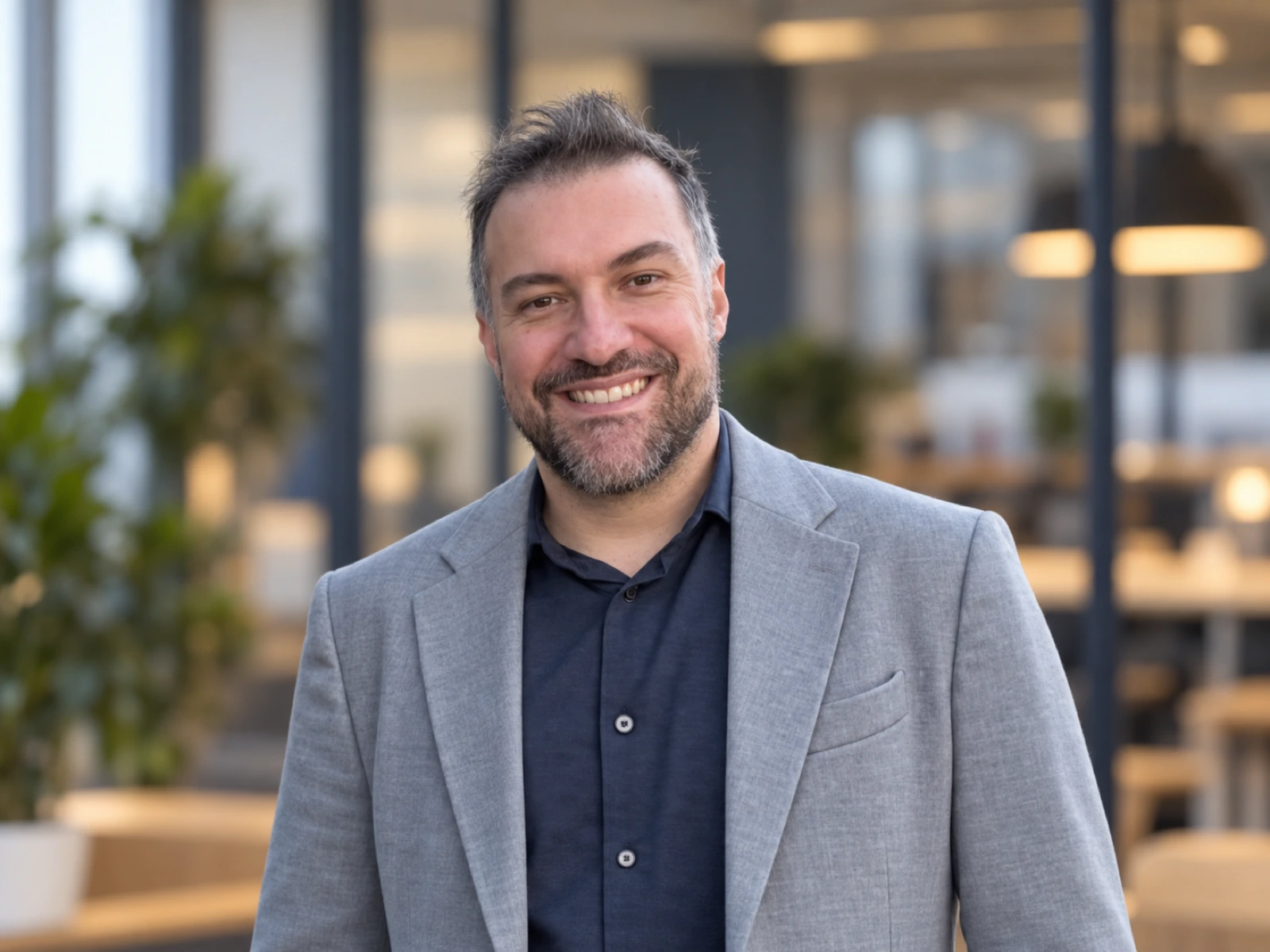
From 9 to 12 November, Coopers took part in Web Summit Lisbon 2026, an event that brought together around 900 speakers and 70,000 attendees from more than 160 countries. We went as part of the Sebrae/PR mission, within the Brazilian delegation organised by Sebrae and ApexBrasil, made up of roughly 300 companies.
Our co-founding partners, Lincoln Alves, Chief Business Officer, and Carlos Souza, Chief Operating Officer, represented Coopers at the event. The trip is part of our internationalisation journey, which includes PEIEX, ApexBrasil's export qualification programme. We went to Lisbon looking for technology, connections and new routes for growth.
The road from Brazil to Europe: we came here to learn everything we can and bring Coopers into this market.
On stage, the debates ranged from the cybersecurity risks posed by AI to the ways it can make public services run more smoothly. The defining takeaway of this 10th edition: AI speeds everything up, but humans are still the ones responsible for the quality of the work.
How does Portugal want to use AI agents in government?
With AI agents that understand what a citizen is asking for, talk to each other and resolve the request, instead of forms and service counters. That was the proposal from Gonçalo Matias, Portugal's Minister for State Reform, at the opening session of Web Summit Lisbon 2026 on 9 November. The idea is called the “agentic state”, and its goal is to make technology work for people, faster and with less bureaucracy.
The warning that stayed with us most came when the minister talked about simplifying the state: “Technology doesn’t fix a process that doesn’t work. It speeds it up.” In other words, putting AI into a messy workflow only makes the mess move faster.
For us, the message applies to companies too: if even the state is redesigning itself around agents, a brand’s channels also need to be built for this scenario. But before putting agents to work, you need to look at the process they are going to speed up.
Is it still worth having your own website when agents do the searching and bring options to the customer?
That was the question Chris Koehler, CMO of Twilio, put to the audience to open his talk at Web Summit Lisbon 2026. His answer? Yes, very much so, because the agent brings the options, but the decision is human. In other words, brands with their own websites hold real value, especially when they have strategies designed for consumers and for agents.
Designing websites for agents has already become a showcase service. During the event, one of the featured exhibitors was offering GEO (Generative Engine Optimization), optimisation for searches carried out by AI. Here at Coopers, we already cover this from diagnosis, with Coopers Audit, to continuous evolution, with Coopers Evolve, combining SEO with AI, content strategy and websites that agents can read.
Who is accountable when an AI agent gets it wrong?
In the same talk, Chris Koehler was blunt: if something goes wrong, there is no point blaming the agent, because the person is the one who signs off.
The same day, we attended a talk that took this discussion into the job market, with a debate on how roles and opportunities are changing in the face of AI. Still, however much the way we work changes, our reading is that delivery and quality get a boost because there is a person with technical knowledge and critical judgement in charge.
That is how we already work at Coopers: we use AI to gain speed, knowledge and decision-making power, and every delivery carries the signature of someone on the team. Machine speed. Human signature.
What risks do AI agents bring to cybersecurity?
The topic took up two talks on the last day of the event. In the first, CrowdStrike showed how a company’s internal AI agents work to block intrusions by external agents. To be useful and autonomous, these agents are given access to emails, files and documents, so the care lies in the right permissions and the right environments.
The second talk showed that AI-driven attacks follow the logic of old social engineering scams, such as the email that pretends to come from a well-known organisation. The trick that can fool a person can also affect an internal agent. Large models help with guardrails, but on their own they are not enough.
In Lisbon, we heard a story that shows why human review still makes a difference. Roland, our partner in Austria, works as a pentester and had a client convinced that if ChatGPT’s agents couldn’t find any flaws in the system, a human wouldn’t either. In two to three days of work, Roland gained root access to the web server. AI analysis helps, but it doesn’t replace the eye of someone who knows how a system is built and how it can be broken.
What connections did we make in Lisbon?
From Austria, besides Roland, we spent a whole day exchanging business cards at the Austrian and German stands, which brought together the Austria-Portugal Club and the Austrian trade agency, dedicated to promoting the country as a destination for business, investment and research. Each of these conversations was one more step on the road to Europe.
From Brazil, we met Gabriel Cirino, a PhD candidate at USP and founder of Braine, which develops solutions to reduce the time and cost of assessing autism, ADHD and other neurodivergences, and is already used in more than 40 institutions. Braine’s mission grew out of its founder’s personal experience, and he now sees internationalisation as the next step. Before that, Gabriel wants to bring the solution to the Curitiba ecosystem, where he has already approached the city’s Sandbox, and sees Coopers as a partner in the region.
From France, we heard the story of élima, founded by Aboubacar Tuo and Maryse Kouassi. Born in Côte d’Ivoire, Aboubacar went to France on a scholarship, earned a PhD in AI and now wants to give back through education what education gave him. The app uses generative AI to explain school content in each student’s own language, with overcrowded classrooms in mind. According to Maryse, the pass rate for the end-of-high-school exam is around 40% in Côte d’Ivoire, compared with about 90% in France. Selected for the Web Summit 2026 Impact Startup programme, élima is preparing pilots in schools and expansion across Africa.
We came back from Lisbon with confirmation that we are in step with what the market is discussing about AI and with how to apply it to everyday work. That is the lens we bring to our clients’ projects: building websites for people and for agents, looking at the process before automating it, and treating security with the care it calls for.
You really get why Web Summit has the name it has, and the value it has.
BUILT TOGETHER.
Co-founder of Coopers. Leads operations, R&D and the adoption of AI across the company.
LinkedIn